

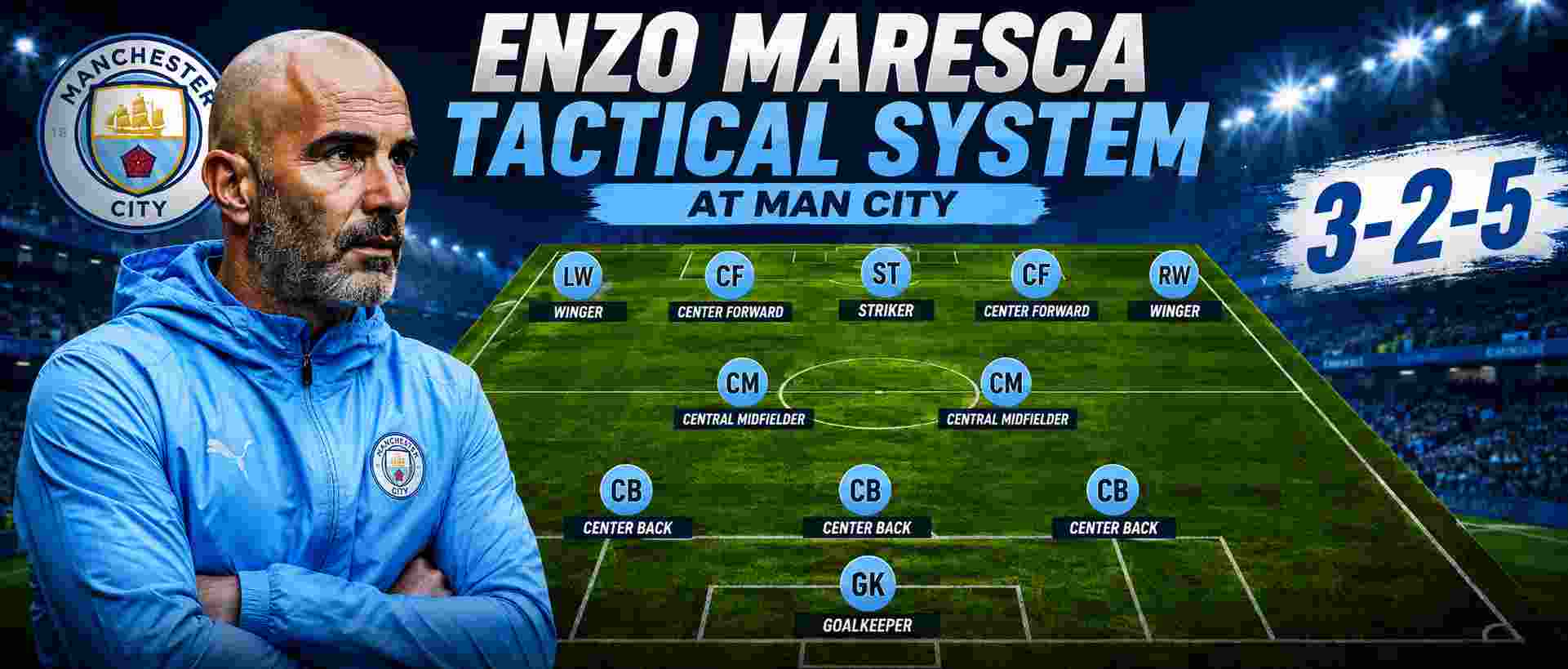
Enzo Maresca Tactical System at Man City
Enzo Maresca has set up Manchester City in a 4-2-3-1 base shape that morphs into a 3-2-5 or 3-2-2-3 once his side settles into possession, the same positional-play framework he used at Chelsea and Leicester. Maresca was officially appointed Man City head coach on 29 June 2026, succeeding Pep Guardiola after his ten-year spell at the Etihad Stadium, and has signed a three-year contract running until June 2029.
Enzo Maresca Man City Appointment: Key Facts
| Detail | Information |
|---|---|
| Appointed | 29 June 2026 (contract from 1 July 2026) |
| Contract length | Three years, until 30 June 2029 |
| Predecessor | Pep Guardiola (departed after 10-year tenure) |
| Previous club | Chelsea (June 2024 – 1 January 2026) |
| Reported compensation to Chelsea | Around £17m ($22.5m), per British media reports |
| Preferred formation (base) | 4-2-3-1 |
| Preferred formation (in possession) | 3-2-5 / 3-2-2-3 |
| Age | 46 (born 10 February 1980, Pontecagnano Faiano, Italy) |
This is Maresca’s third spell at the club, having previously coached Man City’s Elite Development Squad in 2020/21 and served as one of Guardiola’s assistants from 2022, a period that included City’s 2022/23 Treble-winning campaign.
Enzo Maresca Formation and Build-Up Structure
Maresca’s build-up starts from the goalkeeper. Tactical analysis site Squawka describes his sides adding the goalkeeper into a 1-4-2-4 shape from restarts, with the centre-backs splitting either side of him and the double pivot holding a deep central position while both full-backs push forward. That structure is designed to either play through the opposition’s press for a direct four-on-four in the front line, or settle into a controlled build-up phase depending on how the opponent defends.
From there, City shift into the more familiar 3-2-5. One full-back inverts into the double pivot to form a back three alongside the two centre-backs, while the opposite full-back tucks inside to help build a box midfield with the other central players. Squawka’s season preview describes this in-possession shape as designed around manufacturing central overloads to exploit space between opposition lines.
Comparison with Guardiola’s Man City System
| Element | Guardiola’s Man City | Maresca’s Man City (early signs) |
|---|---|---|
| Base out-of-possession shape | Varied, often 4-4-2/4-1-4-1 | Back four, 4-4-2 out of possession |
| In-possession shape | 3-2-2-3 / 2-3-5 | 3-2-5 / 3-2-2-3 |
| Full-back role | Inverted full-backs into midfield | Similar — one full-back inverts, other holds width |
| Build-up trigger | Goalkeeper-included buildup | Goalkeeper-included 1-4-2-4 buildup |
Man City winger Phil Foden, speaking before a 2026 preseason friendly, said the new setup is “very similar to how we played under Pep,” but noted differences in defensive structure and buildup variety, adding the squad has “different ideas about how to play out from the back.”
Enzo Maresca Midfield Options at Man City 2026/27
With Rodri departing for Barcelona during the summer window, Maresca’s central midfield picture has shifted. Squawka’s tactical breakdown outlines three possible midfield configurations for the 2026/27 season:
- Rodri-less double pivot: New signing Elliot Anderson paired with a holding midfielder, with a full-back inverting to form the 3-2 platform in possession.
- Three-man engine (4-3-3/4-1-4-1): Anderson alongside a more mobile central trio when City need extra pressing range and vertical carrying.
- Technical/creative midfield: Jérémy Doku, Rayan Cherki and Foden combining in tight areas, with the deepest midfielder covering more defensive ground.
Man City are reportedly in advanced talks to sign Ayyoub Bouaddi as a replacement for Rodri’s defensive-midfield role, though analysts note he offers more technical control than the tackling and interception numbers Rodri provided — a gap flagged as central to how Maresca’s system holds up defensively when full-backs push forward.
How Maresca’s System Worked at Chelsea
Maresca used the 4-2-3-1 almost exclusively at Chelsea to maximise Cole Palmer’s presence as the No. 10, shifting into 3-2-5, 2-3-5 or 3-1-6 shapes once possession was secure. Right-back Malo Gusto and left-back Marc Cucurella were both used to invert into central midfield positions, forming a diamond in the middle third with the double pivot at the base and an attacking midfielder receiving vertical passes at the top.
In a tactical breakdown of a Chelsea defeat to Man City, analysis site Tribalfootball described Chelsea building from a 3-4-4 base structure, with the double pivot of Romeo Lavia and Moisés Caicedo operating at staggered heights and Enzo Fernández moving into pockets between the lines to create a spare-man problem for the opposition.
Early Results and Squad Weaknesses Under Maresca at Man City
Maresca’s first competitive fixture in charge, the FA Community Shield against Arsenal on 15 August 2026, ended in a 3-0 defeat, exposing gaps in the squad that pre-season coverage had already flagged. Reporting from ExtraTimeTalk highlighted the lack of a recognised defensive midfielder as a particular concern, noting that Maresca’s system — which asks full-backs and attacking midfielders to push high up the pitch — leaves space that needs to be covered by a specialist holding midfielder.
City’s first friendly under Maresca, a preseason tour match against Inter Milan, ended in a 1-1 draw before a 3-1 penalty shootout defeat.
Key Man City Signings Fitting Maresca’s System
| Player | Signed From | Role in Maresca’s System |
|---|---|---|
| Elliot Anderson | Nottingham Forest | Double pivot / box-to-box generalist |
| Marc Guehi | Crystal Palace (Jan 2026) | Centre-back |
| Gianluigi Donnarumma | PSG | Goalkeeper, key to buildup structure |
Elliot Anderson was Man City’s only major midfield addition confirmed by mid-August 2026, alongside 17-year-old winger Jeremy Monga and backup goalkeeper Gerónimo Rulli, with further squad strengthening expected before the transfer window closed.
Related Reading
For further background and full managerial career history, see Enzo Maresca’s manager profile.
