
How We Analyse Teams and Stats Before Every Prediction | Tips180Prediction

How We Analyse Teams and Stats Before Every Prediction
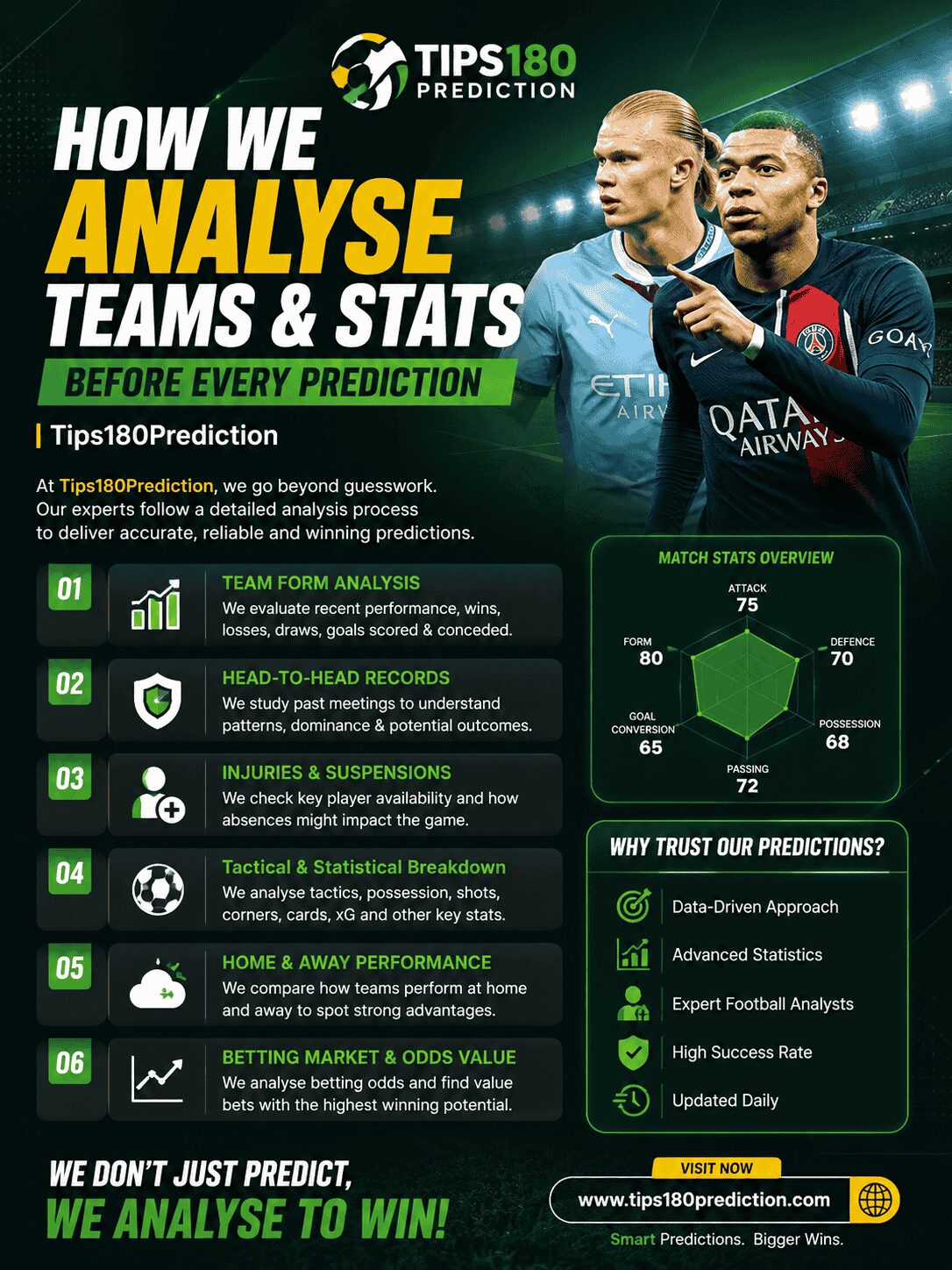
Most losing bets don’t fail because of bad luck, they fail because the research behind them was thin. Here’s how we analyse teams and stats before every prediction we publish, the same groundwork behind every pick on Tips180Prediction, and a process you can run yourself in ten or fifteen minutes before any match.
The Point Isn’t Certainty, It’s Narrowing the Gap
Nobody, us included, can tell you a match is guaranteed. What research actually does is close the gap between what you assume and what’s really likely. A team’s recent injuries, their away record, how they’ve handled a specific opponent before, none of this shows up in a quick glance at the league table, but all of it moves the real odds in one direction or another.
Think of it less as predicting the future and more as reducing how often you’re surprised by it.
Form Tells You Where a Team’s Head Is At
Pull up each side’s last five to ten results, wins, draws, losses, goals for, goals against. A team riding a winning run usually carries that confidence onto the pitch, settled starting XI, sharper finishing, fewer individual errors. A team stuck in a rut is often dealing with something underneath the results, an injury crisis, a tactical rethink that hasn’t clicked yet, or a dressing room that’s lost its rhythm.
One thing worth checking that a lot of bettors skip: who did those results come against? Three wins on the spin means very different things if it’s against relegation strugglers versus genuine top-half sides.
Don’t Assume Home Form and Away Form Are the Same
This is one of the more common blind spots. A side can be nearly unbeatable at their own stadium and toothless on the road, or occasionally the reverse, teams built to sit back and break can thrive away from the pressure of their own crowd. Pull the home and away numbers separately. Blending them into one season-long average can hide exactly the pattern you need to see.
What’s Actually on the Line for Each Team
Two sides can have similar form and still play a match completely differently depending on what’s at stake. A team scrapping against relegation on a Tuesday night away trip tends to show up with more urgency than a comfortable mid-table side with nothing left to play for in May. This isn’t a number you can pull from a stats page, but it shapes how a match is likely to be approached, and it’s worth weighing alongside everything else.
Look Past the Scoreline Into How Goals Actually Happen
Wins and losses only tell you the outcome. Goals scored and conceded per match tell you the shape of a team. Is their defense genuinely solid, or have they been riding a run of good luck and a hot goalkeeper? Are they scoring freely, or grinding out 1-0s against sides that couldn’t create anything? These patterns tend to regress toward the mean eventually, worth knowing before you assume last week’s result repeats itself.
Individual Players Move Matches on Their Own
Team-wide stats miss what a single player can do. Before locking in a bet, check for:
Injuries and suspensions. Losing a first-choice striker or a starting centre-back can undo everything a team’s season-long stats suggested about them.
Expected goals (xG). This measures chance quality, not just the scoreline. A striker scoring well above their xG is likely overperforming and due to cool off, useful to know before backing them again.
Discipline. A player one booking away from a suspension, or a team with a pattern of picking up cards under pressure, matters both for the match itself and for card-related markets specifically.
Head-to-Head Records Are a Clue, Not a Rulebook
Some fixtures genuinely favour one side regardless of current form, a tactical mismatch, a psychological edge, sometimes just a stylistic clash that never seems to change. Worth noting when it shows up clearly.
But don’t lean on it alone. A team that’s won the last five meetings can still lose the sixth, especially if the personnel or form on either side has shifted since those previous matches. Treat it as one data point among several, not the deciding one.
Match the Stats to the Market You’re Actually Betting
Different bets need different numbers behind them:
Over/Under goals. Check how often each team’s matches land above or below common goal lines. A defensively solid, low-tempo side shows up in Under 2.5 games far more often than a high-press attacking team.
Both Teams to Score. Look at scoring frequency and clean-sheet rate for both sides. A team that regularly goes without scoring, or a defense with a strong clean-sheet record, changes what this market is really worth.
Corners, fouls, and cards. Some sides generate a high corner count because of a wide, crossing-heavy style. Others rack up fouls and bookings in physical, high-stakes fixtures. Worth a specific look if you’re betting either market.
The Details That Are Easy to Miss
Fixture congestion. A team coming off a midweek continental match may rotate for the weekend league game, changing both quality and freshness on the pitch.
Weather. Heavy rain or extreme heat can slow a match down or open it up, particularly for teams built around a fast, high-press style.
Travel. A long-distance away trip, especially in continental competition, adds fatigue a simple home/away stats table won’t capture.
Where Bettors Usually Trip Up
Backing a big name purely on reputation, even against a well-organised underdog that’s set up specifically to neutralise them.
Locking in a bet before checking the confirmed lineup, a surprise team-sheet an hour before kickoff can flip everything the stats suggested the day before.
Leaning too hard on one number, a hot head-to-head record or a standout xG figure feels convincing, but it’s one piece, not the whole picture.
Skipping the process entirely when you’re short on time, which is usually exactly when the avoidable mistakes happen.
A Routine You Can Actually Repeat
Rebuilding your process from scratch every matchday is how corners get cut. Run through the same list every time instead:
Recent form for both sides, checked against the quality of opposition faced.
Home and away splits, kept separate, not blended into one average.
What’s actually at stake for each team this match.
Injuries and suspensions, especially to key attacking or defensive players.
Head-to-head history, noted as context, not treated as settled fact.
Underlying goals data, not just the final scorelines.
Whatever market-specific stats match the actual bet you’re placing.
This Is How We Build Our Own Predictions
Everything above is the same process behind our daily predictions on Tips180Prediction, we don’t publish a pick without running through form, availability, and context first. If you want to see it applied to a specific market, our Over 0.5 goals, BTTS, and Sure 2 Odds pages break down how we approach each one.
If you’re after a broader betting strategy rather than just the stats side, our football betting strategy guide covers bankroll management, value betting, and accumulators, and our piece on how betting tips change throughout the year explains why the same stats deserve different weight depending on the point in the season.
Frequently Asked Questions
What’s the best site for checking team stats before betting? FlashScore and WhoScored are solid free sources for form, head-to-head, and match-level stats. No single site has everything, cross-checking two or three usually beats relying on one.
How many games should I analyse before placing a bet? Five to ten recent matches is a reasonable window, enough to catch a genuine pattern without letting one outlier result skew your read.
Are soccer stats always reliable? They describe what already happened, not what’s guaranteed to happen next. Treat them as context that narrows uncertainty, not as a promise.
Should I still analyse matches when using free bets? Yes. A free bet lowers your financial exposure on that specific wager, but the same research still improves the odds of it landing, there’s no reason to skip your process just because the stake isn’t fully your own.
Responsible Betting
No amount of research guarantees a win, betting always carries real risk. Only stake what you can afford to lose, and treat analysis as a way to make better-informed decisions, not a way to remove uncertainty. If betting stops being fun or starts to feel like a problem, please seek support through BeGambleAware, GamCare, or a local responsible-gambling service.
